Dylan’s Story
"I got out of [Penobscot County Jail] and I went right back to using and the same routine. I don’t think jail is the answer to substance use. You can put people in jail, but they don’t learn anything.”
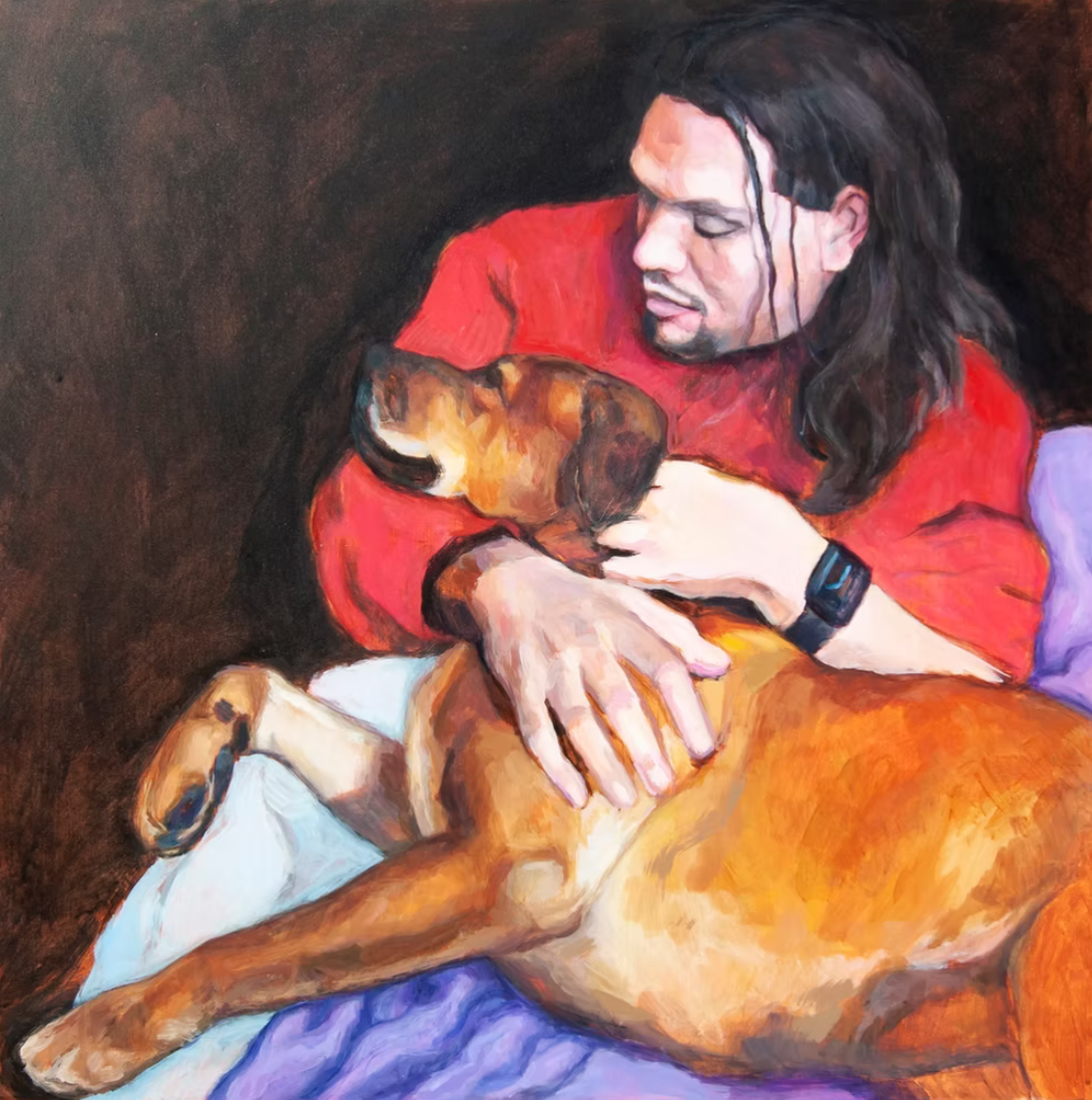
“Dylan and Bear” by Elizabeth Schule. Acrylic.
Before Dylan ever entered the Penobscot County Jail, he was already struggling to survive. He was homeless, living with a substance use disorder, and physically dependent on opiates.
Jail didn’t interrupt that reality; rather, it intensified it. The moment he was booked, his body began to withdraw, and the place he landed offered no help.
During his 45 days inside, Dylan endured untreated withdrawal, something that is both dangerous and completely preventable. Effective medical care for withdrawal exists, and makes the process much safer. But in the jail, none of it reached him.
When Dylan asked for help, he was treated with suspicion. Staff labeled him as “drug-seeking,” a stigmatizing label used to deny medication even when it’s medically necessary. Inside PCJ, this kind of denial is common—treatment can be withheld for any reason or no reason at all.
“They didn’t take my detox seriously and didn’t put me on any protocol. They just probably assumed I was looking for meds. It took me two weeks to even see someone for mental health. When I finally saw the ‘med lady,’ it was a week in, and they told me my detox wasn’t bad enough, or I hadn’t been there long enough.”
By the time he left jail, Dylan was still sick and still without support. He returned immediately to the only coping strategy he knew. “I got out of PCJ and went right back to using,” he said. “I don’t think jail is the answer to substance use. You can put people in jail, but they don’t learn anything. There’s a lot to learn when it comes to substance use in jails.”
What Dylan wanted most was basic human dignity. Clean clothes. Being treated like a human being. But even those simple needs went unmet. PCJ is well known for its filthy conditions, and to Dylan, the dirt felt like a message.
“It’s really gross there,” he said. “They treat you like an ‘inmate,’ which they should, but you’re still human. If you need a change of boxers, it shouldn’t take over 24 hours.”
Cleanliness was only one part of the harm. There were darker moments that revealed how little the wellbeing of incarcerated people mattered to those in charge.
“An inmate tried to hang himself,” Dylan recalled. “The guard ignored it and slammed the door shut. Instead of treating it like a suicide attempt, they treated him like shit—told him he’s stupid, said, ‘What the &%$! are you doing.’ They totally called him out and then put him in segregation.”
Jails currently function as our society’s response to poverty, homelessness, and addiction. But not only do jails fail to solve these problems, they actively make them worse.
Dylan’s story is not unique — we wish that it was. But after speaking with dozens of people incarcerated at PCJ, we see this as a highly typical story, one that produces no positive outcomes for Dylan or for society.